
In Korean legends and fairy tales, animals take on anthropomorphic features, emphasizing their emotions, showing the fears and virtues of the human being.

- Pinterest web photo
In Korea, legends involving the tiger and the hare are an integral part of the country's rich cultural heritage. One of the best known stories is that of the "Tiger and the Hare", which illustrates the cunning and ingenuity of the hare in contrast with the strength and power of the tiger. According to this legend, the tiger, hungry and looking for food, meets a hare and decides to capture it to satisfy his hunger. However, the hare, with his cunning, manages to deceive the tiger several times, finally managing to save himself.

- Pinterest web photo
The story not only highlights the hare's sagacity, but also serves as a moral to teach that intelligence and cunning can overcome brute strength. In many versions of the legend, the hare uses various stratagems, such as pretending to be a friend of the tiger or exploiting the surrounding environment, to escape predation. This tale is often told to Korean children to encourage critical thinking and Smoking tigers are a curious and fascinating element of many Korean stories and legends. The tiger, in general, is a powerful symbol in Korean culture, representing strength, courage and protection. However, when a tiger is depicted smoking a pipe, it takes on a different meaning, often linked to wisdom and longevity. This image is especially well-known in "dureong" (도령), a folk art form that uses simple, humorous drawings to tell stories.
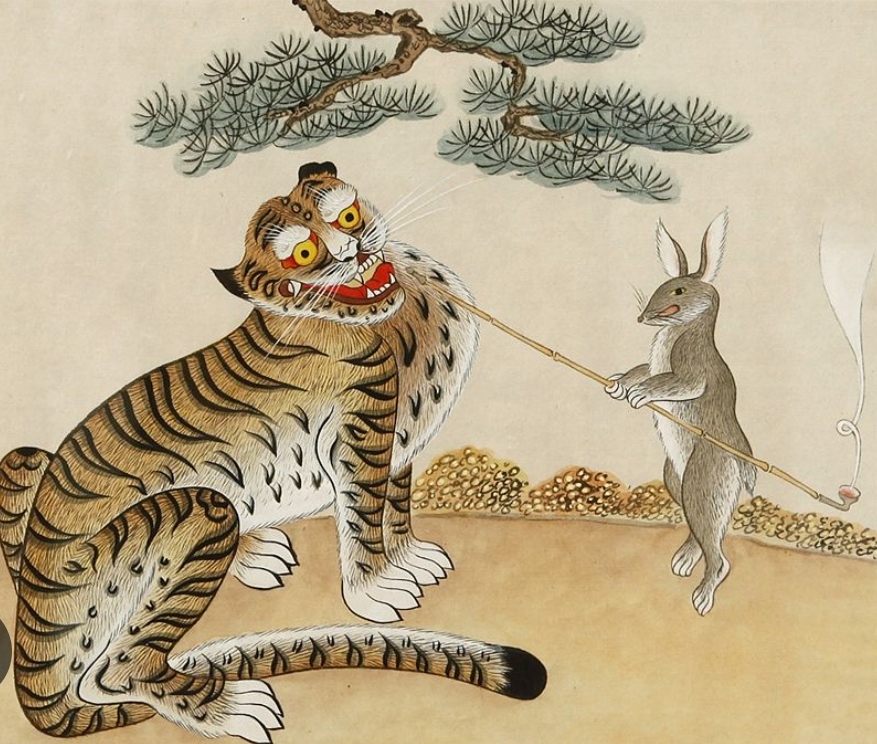
- Pinterest web photo
The figure of the smoking tiger can be seen as a way of humanizing the animal, smoking a pipe, a typically human activity, suggests that the tiger is not only a wild creature, but also a thoughtful and wise being. The Smoking Tiger also embodies a certain humor and a lot of irony. The contrast between the fearsome image of the tiger and the domestic act of smoking creates a comic effect that captures attention and entertains.
This depiction can be found in many folk tales and works of art, where the tiger often offers wise advice or serves as a spiritual guide for the protagonists.

- Web photos from Pinterest
In Korean stories, these legends also reflect aspects of Korean philosophy and spirituality, where animals are often symbols of certain virtues or character traits. The tiger, for example, is often seen as a symbol of power and authority, while the hare represents intelligence and the ability to adapt.
In Korean legends, the hare occupies a prominent place and its role is often linked to stories of cunning and survival. One of the best-known legends is that of the hare who risks his liver to save himself and his friends. According to this story, a sea dragon, which lived in the depths of the ocean, fell seriously ill. His doctors recommended eating a hare's liver to heal. So, the dragon sent a tortoise to look for a hare.

- Photo credit Paola Pelissa Korean fairy tales


- Photo credit Paola Pelissa Korean fairy tale book.
The turtle, cunning and persuasive, managed to convince a hare to follow him to the dragon's kingdom with the promise of a wonderful underwater palace full of delights. However, once he reached the depths of the ocean, the hare discovered the real reason for his invitation. With a quick mind and a brave heart, the hare told the dragon that he had left his liver on land, for he did not imagine he would need it at the bottom of the sea. The dragon, believing the hare, let it return to the ground to recover the liver, but the hare, once free, never returned.
This legend not only highlights the hare's cunning and intelligence, but also serves as a warning about trust and prudence. It is a classic example of how Korean fairy tales and legends use animals to teach moral values and life lessons, passing on wisdom and culture across generations. The figure of the hare, therefore, becomes a symbol of ingenuity and survival, a hero who manages to overcome dangerous situations thanks to his brilliant mind.
Paola Pelissa