
Who among you aspiring users of Korean cosmetic products has never seen a Korean historical drama? If you haven't already done so, I advise you to run and open it Netflix, or better yet Viki Rakuten, to choose your historical drama. My favorite is “Moon Lovers Scarlet Heart Ryeo”, where the protagonist, the idol IU, finds himself, by a twist of fate, traveling back in time to the reign of Taejo, founder of the Goryeo dynasty. As an ordinary girl who sells cosmetics, she finds herself at Palazzo Reale making friends with the princes of the time. I won't tell you the whole story, don't worry, but there are many scenes where the protagonist puts her knowledge of modern cosmetics into practice, to create beauty creams and BB creams, which will help a very dark prince, played by the actor Lee Joon-gi.

USE OF SOAPS AND OILS IN ANCIENT TIMES
Since ancient times, the figure of the healer has always been present and often helped the population thanks to his knowledge of medical herbs and roots. Already before the reign of Silla (668-935 BC), both men and women used scrubs and ointments to keep their skin healthy, used powders to make it appear lighter and tried to keep the eyebrow arch very thin, thanks to the Chinese influence.
In the Goryeo Dynasty period, they caught on cleansing soaps deriving from mung beans, which when soaked in water, released the famous saponin. The foam was simply released (you can also see it when you rinse the chickpeas in the jar) and rubbed on the affected part.
The Oils Of fishing e apricot were used to brighten the skin, those of safflower to hydrate and those of camellia e castor to make your hair shiny.
A sort of masks were already used to brighten and whiten the face, made from the powders of rice e mile grind and mix with oil or water, so that it sticks to the face.
The eyebrow dye was extracted from the vegetable ashes in brown, black and indigo colors. I would love to see a character from the era with indigo eyebrows!
Lip tint and blush were extracted from the flowers of safflower.

COSMETICS IN THE JOSEON PERIOD
In the period of the Joseon dynasty (1392-1897), with the advent of Confucianism, even make-up was influenced by the idea of emphasizing the beauty of the soul, rather than appearances: make-up was even lighter, allowing candor and true natural beauty to shine through. This idea of beauty still remains in Korean makeup, the makeup is there but you don't notice it. In this historical period, the production of cosmetics began to grow, women used tonics to be applied to the skin of the face with extracts of cucumber, motherwort and pumpkin, to hydrate and purify.
The thing that has always amazed me is the consumption of collagen, which has been discovered to bring many benefits since ancient times; already in these times many women made compresses with pig skin, which contains a large quantity of collagen. If you happen to eat porchetta, remember to get the skin, which is delicious and crunchy, to use, so even if you put on a few pounds, you won't feel guilty because you will have wonderful skin!
In this historical period, skin without imperfections was seen as a noble and above all sign of good health.
The Joseon period represents a turning point for cosmetics and for a series of "female stereotypes", which the society of the time was facing: women had to appear virtuous, elegant and with a well-groomed appearance.
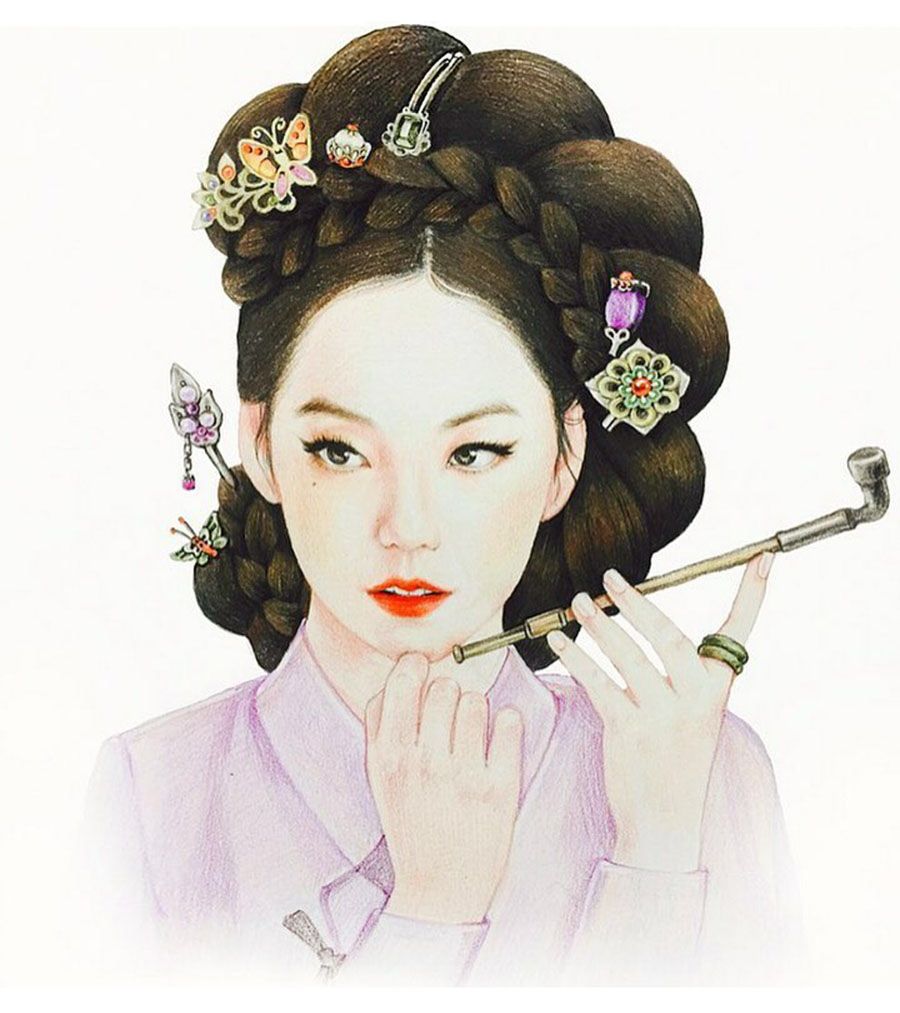
Sambaek the three characteristics of white: white of the skin, white of the teeth and white of the eyes. Most likely because a slightly rounder shape, which revealed the sclera, was more appreciated). Samheuk the three black features: hair, pupils and eyebrows.
Samhong the three red features: the cheeks, the lips and the nails. For the nail polish they didn't use a red one, but one more tending towards a light peach, obtained by rubbing some flowers of that colour.
GISAENG
Just as we nowadays often try to take inspiration from famous actresses and show business personalities, even at the time women tried to look their best and copy the trends and beauty standards of "Gisaeng", women who entertained the various important personalities of the time with dances and songs. They were considered the emblem of fashion and were the ones who could dare the most with make-up, as women who had to be very attractive to clients for work. In historical dramas, the young protagonists often find themselves in the houses of the Gisaeng, where they undergo a real makeover from make-up to hairstyle, to precious silk dresses.

In the 1920s, Japanese cosmetics dominated the market, the result of the colonization of the latter.
After the Korean War, imports of foreign products were banned in 1961 and the Korean cosmetics industry began to take off.
In my opinion, Korean Skincare is the best, I have tried a myriad of products from various Italian and French brands, but none have had such amazing results. Korean cosmetics is very technologically advanced compared to the rest of the world and fortunately it is also opening up to the Western market.
Vanessa Ranauro
Copyright ⓒAll rights reserved
Credits: Pinterest and Pexel cover photo