
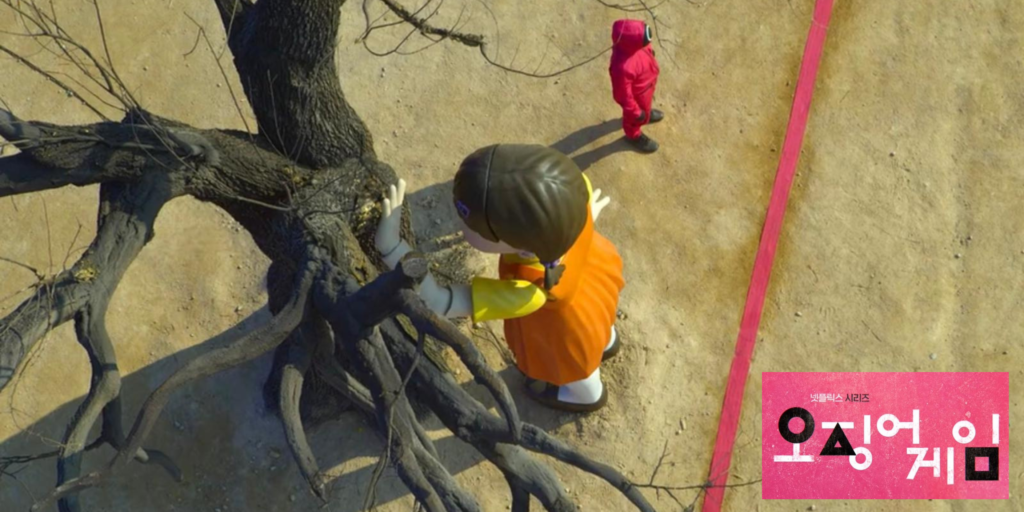
Title: Squid Game (오징어게임)
Direction: Hwang Dong Hyuk
Series: 9 episodes distributed on the Netflix platform
Plot: tells the story of 456 people who risk their lives in a deadly survival game, which offers 45.6 billion won, equal to approximately 33 million euros.
Let's analyze Squid game
Intrigued, having read about the series Netflix Squid Game, I decided to watch it. To say I liked it is an understatement. I was immediately passionate and involved in the vision, to the point that I couldn't stop it. The criticisms and messages regarding this production are diverse and wide-ranging; therefore, it was difficult to get a clear picture of the story; however, the following matches my observations.
This gripping and distressing story comes from the mind of the creator/director Heang Dong-hyukh, who used many elements of his personal experience, to reveal the stark reality of South Korea's current socioeconomic problems, problems that reverberate with our own in the West. The realistic scenario, in an absolutely chilling way, reveals the suffocating truth of South Korean capitalism, while the protagonists fight against the exploitation of which they are victims.
After an initial financial surge in the post-war period, South Korea is today the Asian state with the most serious economic disparity. It is a country with mass youth unemployment, with an economy managed by a group of prestigious companies, which suffocate citizens with the highest levels of social pressure. In Korean there is even a phrase that describes the act of borrowing money in an attempt to achieve the same economic well-being as the previous generation.
The Covid-19 pandemic has only made the situation worse. The government has in fact streamlined lending regulations, allowing young people to easily access large amounts of money, causing a drastic surge in debt levels. It's no coincidence that South Korea is one of the largest cryptocurrency markets!
In this series the players are all suffocated by debt and participate in the game with the sole aim of saving themselves, both physically and economically; a clear reference to the condition of many young South Koreans who describe their country as hell, in which living is like wandering without light and without knowing when the darkness will disappear.
There has been no shortage of criticism from political factions, as the series reveals, which have condemned the entire competition, seen as an exercise in humiliation by the right, as it reveals to the whole world the secretive dynamics of South Korea and a cause for real concern for the left, for what it says about national characteristics.
Who are the participants in this deadly competition?
In short, financial conditions and problems lead 456 people to accept a strange invitation to a deadly competition in which, with a large sum of money at stake, they are promised solutions that should ideally solve their difficulties. We are also shown the range of problems that arise from this level of dysfunction, as the characters try to deal with this profound tension, characterized by ineffective patterns of behavior and personality disorders.
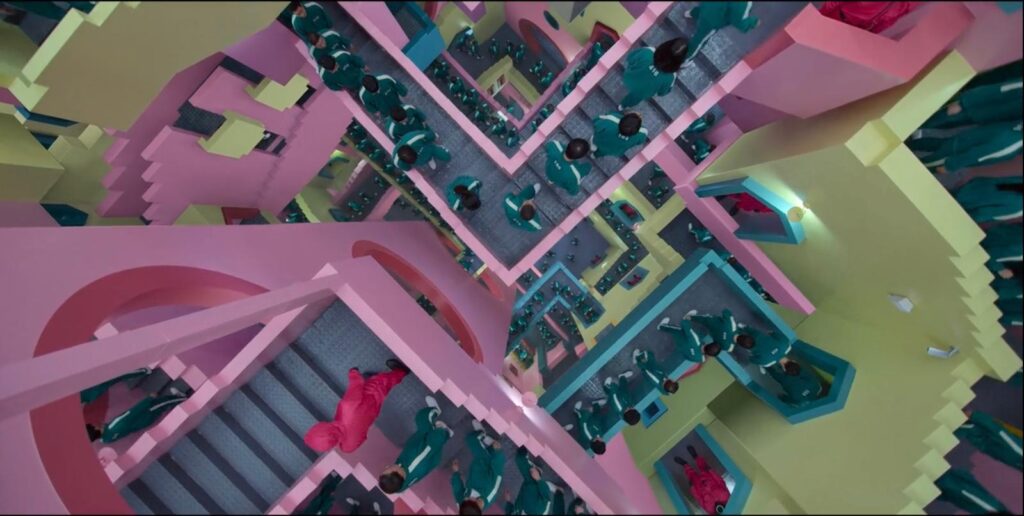
These people are destined to fail in this society, victims of a system that reveals that, regardless of the amount won, nothing will change for them and that they are destined to remain actors in a drama much bigger than they could ever imagine. Squid Game is a window onto a murderous, ruthless and corrupt society, in which power cancels the rights and personality of the individual and where the rules are no less absurd and cynical than the slimy and devious ones to which we are all subjected in the real world. The rules within the game are in fact no worse than those in the daily life of each participant. Squid Game is a tragedy, part horror fable and part urban noir, that demonstrates how everyday life can be oppressive and unbearable.
The psychology of Squid game
On a psychological level, Squid Game precisely describes what can be defined as the main source of stress for contemporary human beings, that is, the economic hell in which all of us, rich or poor, live. An economic hell that has a double face, a kind of refuge, of fictitious relief, a world of strong rewards, which allows people to endure the increasingly demanding system, continually draining their life force. In this series, all the fragilities that characterize us are covertly expressed, from substance abuse to genetic disorders, as well as a series of variables that profoundly affect our destiny. Furthermore, each of us is immersed in a system that is also based on rather dystonic aspects, such as the logic of large numbers or on the notion of mass consumption, consumerism and marketing, each aspect point of a hierarchical pyramid that alters the mind negatively and creates capitalist well-being. The opposite extreme, that of the disinherited and the great poor of the earth, constitutes the base of the pyramid, while between these two extremes the middle class, to which the majority of people belong, lives a turbulent existence, always poised between happiness and misfortune.
This balance is obviously precarious and the middle class protagonist of Squid Game interfaces with both great opportunities and the prospect of ruin, should they reject what is officially decreed by capitalism (from the purchase of properties intended for certain types of employment, up to the aforementioned cryptocurrencies). The economy makes us all prisoners through the need to earn and simultaneously drain our salaries. In this context, even a moment of pleasure becomes illusory, nevertheless, we continue to waste money on unhealthy habits, in those deadly traps that we consider our "satisfaction". This series addresses these brutal aspects, showing a cycle of dopamine-like addictions; the negative cycle of consumerism that unburdens us all.
Many commentators have argued that this series is harmful to young people. It is clear that they see the absence of educational utility, since children can certainly understand that the deadly game does not reside in the competition to which the competitors are subjected, but in that of the society that allows it. The scenes of violence and murder show how every single person killed corresponds to a crude representation of individual exasperation, since the life of each participant is a real living death and corresponds to a reality much worse than that reproduced in the game.
Is it better to live inside or outside Squid Game?
Perhaps the only human solution could be a real awareness of what is happening around us. There are no Hunger Games. They are the games of spiritual devastation. Knowledge is the only true means of survival. Luck is just part of the game.
"What we see in the series is something that we can all understand because it concerns us directly. What we see is something that can happen to us too and that can harm both ourselves and the people around us. The real message that Squid Game wants to convey is that we should think more about others. In the series we see survival games in which there is conflict between people. However, there are games in which, without unity, one cannot survive. Many viewers think that there are scenes of violence that are essential to create audiences and guarantee the success of the series, but we didn't do it for this, but to make the public understand where this violence comes from, understand the cause, create awareness and how essential unity between people is to avoid being suppressed. Unfortunately, no one person alone can change the world, but all together, step by step, we can make it at least a better place."
Lee Jung-jae (Player 456) Florence, April 2022


Credit: Photos taken by Elena Caldera during the 2 days of masterclass in Florence with Lee Jung-jae
Elena Caldera
Photo credit: Elena Caldera and taken from the Squid game trailer
Thanks to Claire Palmer, adapted by David Erdos
Translation Barbara Banchero