
The Lunar New Year, despite the strong Westernization of Korea, still remains one of the most important holidays of the year. It is based on the lunar cycle and, like the Chinese calendar, each year is represented by a different animal, which repeats every twelve years. This is the year of the rabbit, a quiet and gentle animal, elegant and lucky. The Lunar New Year has a variable date and in Korea it usually falls on the second new moon after the winter solstice, between mid-January and mid-February. In 2023, the beginning of the new year begins with the January 22nd and, since it is a national holiday, 3/4 days of celebration are recognized to allow all Koreans to be able to return home and celebrate with their family and pay homage to their ancestors. The exact number of holiday days depends on what day of the week Seollal falls on.
How is it celebrated?
Apparently our two countries are once again diverging when it comes to parties. In Italy, Christmas is usually spent with the family and New Year's Eve with friends partying. In Korea, as we have seen, it is completely the opposite and the Lunar New Year is celebrated at home with the closest relatives.
On the occasion of the Lunar New Year, families gather, eat together and play many traditional games, such as Yut, Tuho or Jegi-Chagi. Rectangular kites called Yeon, to make bad luck and negative situations fly away. Very often these kites are built in the family. Another custom practiced in Seollal is to hang i bok jumeoni, lucky bags, because these beautifully embroidered bags are believed to bring luck and happiness to the owners. If on the morning of Seollal you hear the magpie singing, which is one of the symbols of Korea, it is a good omen for the new year.
But let's find out more closely how Seollal is celebrated, what other customs are typical…
Sebae (세배)
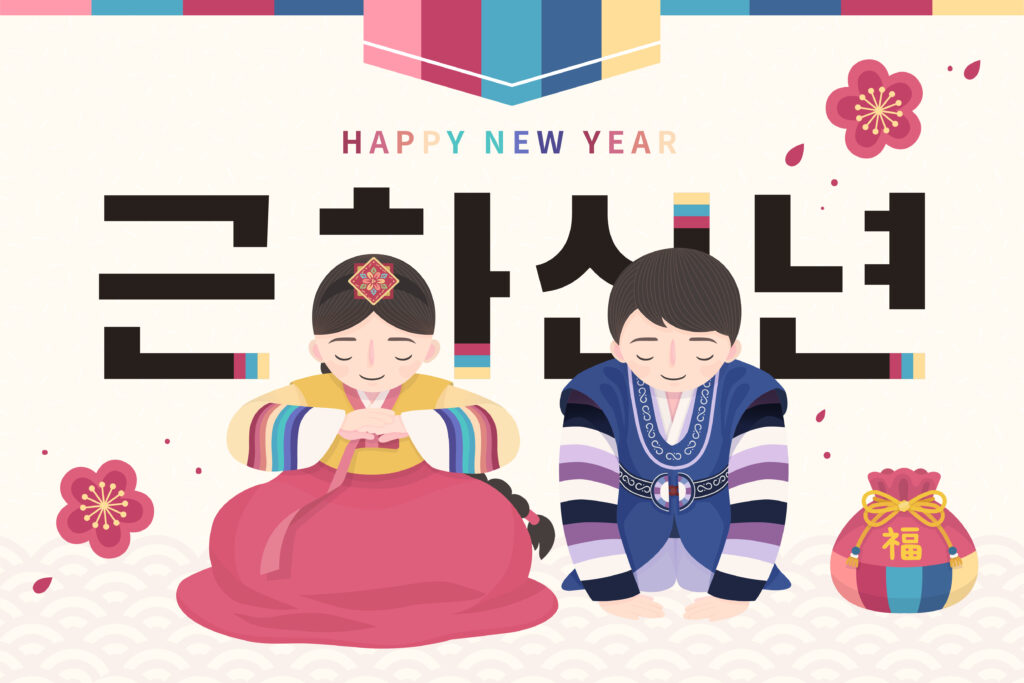
(Korean new year with two people doing bow in hanbok, Happy new year written in Hangul)
One of the most important traditions of the Korean Lunar New Year is Sebae, the act of kneeling on the ground and bowing so that the hands are also extended to the ground. The young people bow to the elderly and wish them "much health and good luck for the new year". This deep traditional bow signifies respect. The elderly reciprocate the wish by giving a tip for the younger ones, the sebaetdon. They are worn hanbok, traditional Korean clothes, while performing in the sebae. Children bond with the lives of their hanbok i bok jumeoni. In these colorful silk cloth bags they put the money they receive after bowing. The amount they receive after sebae varies according to their age, younger ones receive less than older kids.
Charye (차례)
Another important tradition is the Charye, when, on the first day of the holiday, Koreans pay homage to their ancestors. Food is offered and placed on a table as a gift to one's ancestors, behind which are the family's ancestral tablets. People perform deep bows to show respect to their ancestors.
What is traditionally eaten in Korea on those festive days?
One of the foods that is consumed during Seollal is the jeon, a dish similar to a pancake, which often contains green onions, all types of fish, vegetables, pork or cow meat… in short, you can fill it however you like.
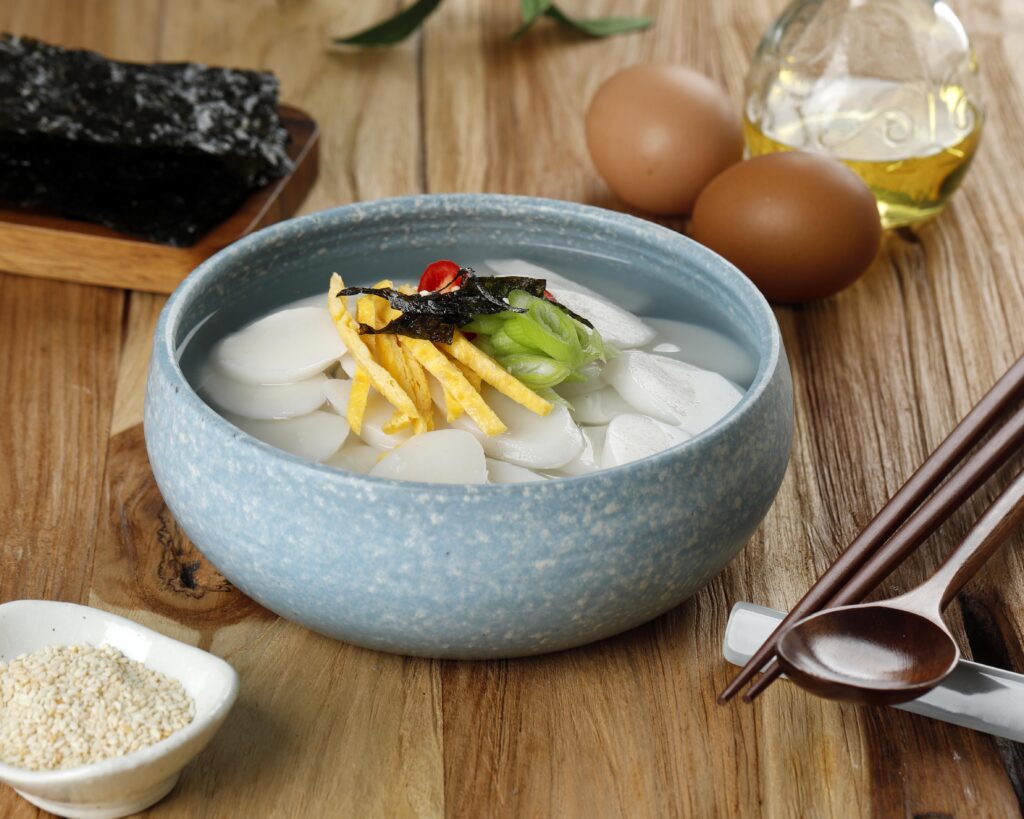
Of course, we can forget about counting lentils on New Year's Eve to get lucky. In Korea we eat it soup tteok. It is, in reality, a solid mixture of glutinous rice rather than a soup where pieces of egg, meat and seaweed are often added. But just like our lentils, by eating this dish you get luck for the coming year. And apparently eating tteokguk soup, according to tradition, makes you a year older. This actually happens because it is customary for Koreans to add an extra year to their age on Lunar New Year. Even though since the solar calendar was adopted in Korea too, the extra year starts directly on January 1st… at least until June, when finally the very complicated system of calculating the years in Korea will become the same as that used throughout the rest of the world.
The symbolism of the Tteok
Returning to our plate, then the act of eating tteokguk It only ages you a year if you eat it on New Year's Eve and not at other times of the year. The oval shape symbolizes a bright and prosperous new year. White indicates purity. In the past this meal was eaten exclusively during Seollal. However, nowadays, they also eat it during the Solar New Year where, as I said, they now age a year but you can find it in restaurants all year round.
We leave you with the little song they teach children at school for Seollal. The song includes all the traditions we talked about in the article. The song begins by talking about the last day of the previous year which in Korea is called Magpie New Year.
Fabiana
P.S.: Special thanks to my Korean friends at HelloTalk and Yongho who were invaluable sources for writing this article.
Cover and article photo credit: depositphotos