
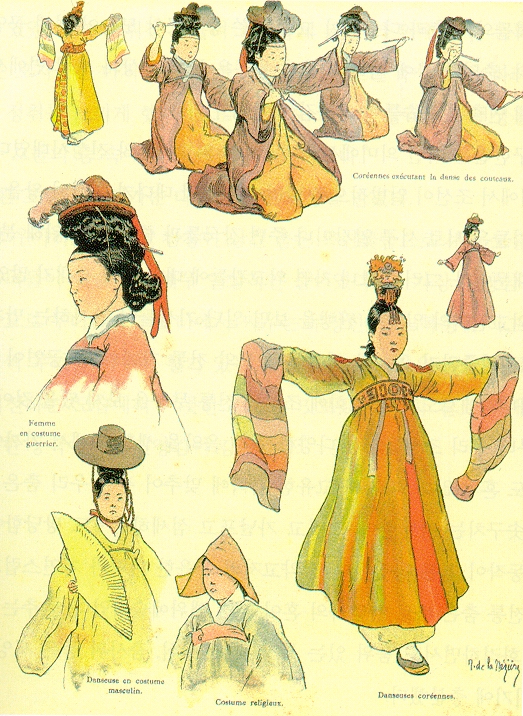
Gisaeng were professional artists in traditional Korea, mainly active during the Goryeo and Joseon dynasties. These women were trained in various arts, including music, dance, poetry, and calligraphy, and often served as entertainers for the aristocracy and royal court. Gisaeng were similar to Japanese geisha, but with some cultural and historical differences specific to Korea.
Gisaeng received rigorous training at institutions called "Gyobang," where they learned not only the performing arts but also literature and appropriate manners of behavior for interacting with nobles. Gyobang were institutions in dynastic Korea that played a crucial role in managing and promoting traditional arts, particularly during the Joseon period (1392-1897). These institutions were essentially academies or government offices dedicated to the training and management of Gisaeng.
The Gyobang were also centers for the preservation and transmission of traditional Korean culture. Here, Gisaeng received rigorous training that included not only performing arts, but also learning social etiquette and ceremonial customs. This prepared them to participate in official events and interact with society's elites in an appropriate and refined manner.
In addition to their educational function, the Gyobang also had administrative importance. They managed the Gisaeng's activities, organized performances and kept detailed records of the artists. These institutions were overseen by government officials and had a significant impact on maintaining artistic and cultural standards in the country.
Gisaeng were therefore considered guardians of Korean culture and artistic traditions and played an important role in banquets, ceremonies and official occasions. Many Gisaeng were also accomplished poets and writers, and some of their works have survived to the present day.
Despite their talent and training, Gisaeng occupied an ambiguous position in Korean society. They were often considered figures of entertainment and did not enjoy the same social status as women belonging to noble families. However, some Gisaeng managed to gain great respect and influence the culture and politics of their time. Their artistic and cultural legacy remains a fascinating aspect of Korean history, and their stories continue to inspire many modern works of literature and cinema.
Gisaeng and concubines were two distinctive figures in Korean society, but they had very different roles and status. Gisaeng were professional artists trained in various and were highly respected for their artistic and intellectual abilities.
Concubines, in contrast, were women who joined the family of a noble or royal man as secondary partners to his primary wife. Their main role was to secure male heirs and consolidate political and social alliances. Unlike the Gisaeng, concubines had a direct connection to their partner's family and often lived within the same house or palace. Their social position could vary widely, with some enjoying considerable influence and others remaining in a state of subordination.
In summary, while the Gisaeng were recognized and appreciated for their artistic and cultural skills, the concubines had a more domestic and political role, linked to the family and procreation. Both figures reflect complex aspects of historical Korean society, and their study offers valuable insights into the era's gender, power, and cultural dynamics.
One of the most famous Gisaeng is Hwang Jini, who lived during the Joseon Dynasty in the 16th century. Also known as Myeongwol, meaning "Bright Moon", Hwang Jini was famous for her beauty, literary talent and musical skills. His poems, often focusing on themes of love and nature, are still studied and appreciated today. Her life has become the subject of numerous literary works, films and television series, making her an enduring cultural icon.
Another notable Gisaeng is Non Gae, known for her heroism during the Japanese invasion of Korea in 1592. According to legend, Non Gae lured a Japanese general to a cliff and jumped with him into the Nam River, sacrificing her life for her country. This act of courage made her a symbolic figure of Korean patriotism.
The Gisaeng were officially ousted during Korea's modernization period, which began in the late 19th century and intensified in the early decades of the 20th century.
With the onset of Japanese colonial rule in Korea in 1910, Korean society underwent profound transformations. Traditional practices began to decline under the influence of new policies and reforms imposed by the Japanese. During this period, the Gisaeng system began to be seen as archaic and incompatible with the modernized and industrialized vision that the colonizers intended to promote. Furthermore, the Gisaeng were often victims of exploitation and abuse, which further contributed to their progressive displacement.

The role of the Gisaeng continued to decline even after the end of Japanese colonial rule in 1945, as South Korea further westernized and modernized. Today, the figure of the Gisaeng is primarily relegated to history and popular culture, depicted in museums, books, and films that seek to preserve and commemorate this unique aspect of Korean tradition.
Article cover photo from Pinterest.com
PAOLA PELISSA
L
I