
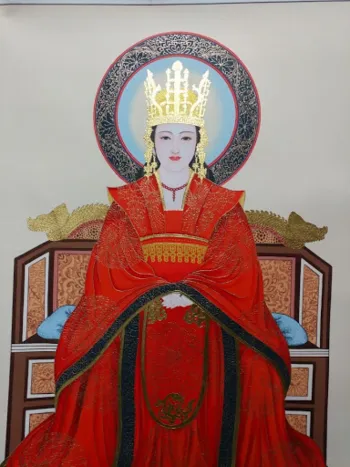
Queen Seondeok of Silla is one of the most fascinating and influential figures in Korean history. Born around 606 AD, Seondeok, whose name was Deokman, was the first woman to ascend the throne of Silla, one of the three kingdoms of Korea, ruling from 632 to 647 AD. Her rise to power was an exceptional event, since in that period female leadership was extremely rare and often opposed. Emperor Jinpyeong, her father, having had no male children to pass down the bloodline and therefore no heir, decided to let her rise to the throne with a law established specifically to be able to continue her lineage, completely reworking the social class system which saw the royal families in power who belonged to the so-called "Sacred Bones" Seonggol.
The move was not entirely unprecedented: high society women in Silla society had a considerable degree of influence and power, and some had managed to rule as regent for their children or grandchildren in the past (Queen Dowager Sado, Seondeok's great-grandmother had ruled as regent when she was thirteen). However, Jinpyeong's decision had sparked many discontents and was greeted with controversy; even before Deokman ascended the throne, the nobles Ichan Chilsuk and Achan Seokpum planned a rebellion in 631 but failed in their plan and were executed, along with their families.
Seondeok proved to be a capable and visionary leader, contributing significantly to the prosperity and stability of her kingdom.
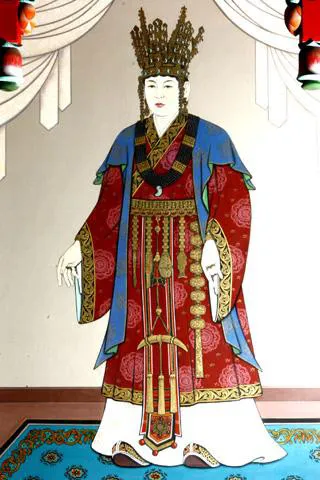
One of Seondeok's best-known contributions was his commitment to promoting culture and education. During his reign, he actively supported the development of arts, literature and science. One of his most famous works is the Cheomseongdae, the oldest astronomical observatory in East Asia, demonstrating his interest in astronomy and science. Furthermore, Seondeok promoted Buddhism as the state religion, building numerous temples and promoting the spread of Buddhist teachings, which contributed to strengthening the spiritual and cultural unity of the kingdom.
Queen Seondeok is also remembered for her thoughtfulness towards her people, political wisdom, and strategic skills. He faced numerous internal and external challenges during his reign, including conflicts with the neighboring kingdoms of Baekje and Goguryeo. Thanks to his intelligence and diplomacy, he managed to keep Silla relatively stable and lay the foundation for the future unification of the Korean Peninsula under Silla's reign. Her legacy continues to be celebrated in Korea, where she is seen as a symbol of female leadership.
Regarding her private life and marriage, there are no historical records to indicate that Queen Seondeok ever married. Her private life is shrouded in mystery, and this has given rise to numerous hypotheses and fantasies, even in the cinematographic field, there have been numerous films that document and sometimes fictionalize her story, but it is believed that she dedicated most of her life managing her kingdom trying to keep her power stable, she wisely stood up to the government and its diplomats and was very interested in promoting Buddhist culture and religion. The decision not to have entered into a marriage may have been a deliberate and well-considered choice, to avoid the political complications that could arise from a marital union, sometimes unwelcome and opposed, internally by other families of royal blood, thus maintaining direct and independent control over his kingdom.
After her death in 647 AD, Queen Seondeok was succeeded by her cousin, Queen Jindeok. Jindeok was also one of the few queens in Korean history and continued many of her predecessor's initiatives, including promoting Buddhism and strengthening the centralization of royal power. Jindeok's succession highlights how female leadership was not only accepted but also respected in the Silla kingdom, a sign of the progressiveness of this ancient Korean society.
Paola Pelissa