
THE'hangul (한글), if referring to South Korea, or chosŏngŭl (조선글), if we refer to North Korea, is a very recent alphabet compared to the birth of the Latin alphabet which dates back to the 8th century BC.
Hangul is a phonetic alphabet, i.e. the set of symbols used for the graphic representation of the sounds of a language. Its essential prerogative is to uniquely associate a single graphic sign with each phone, just like the Latin alphabet.
The form of this alphabet that is used today, however, does not coincide perfectly with the one used just after its birth, since a process of simplification has taken place over the years.
However, before this wonderful alphabet became the official language, we had to wait until 1945, a symbolic date for many countries…
Where does the name come from?
Literally hangul (한글) means both "big alphabet" in ancient Korean and "Korean alphabet" in modern Korean and was coined by the Korean linguist Ju Si-gyeong (주시경) in 1912.
Hunmin Jeong-eum (훈민정음) is the original historical name, while North Koreans adopt the name Chosŏn'gŭl (조선글) because they give Korea a different name: Choson (조선).
But who invented it? Where does the need to coin a new alphabet come from?
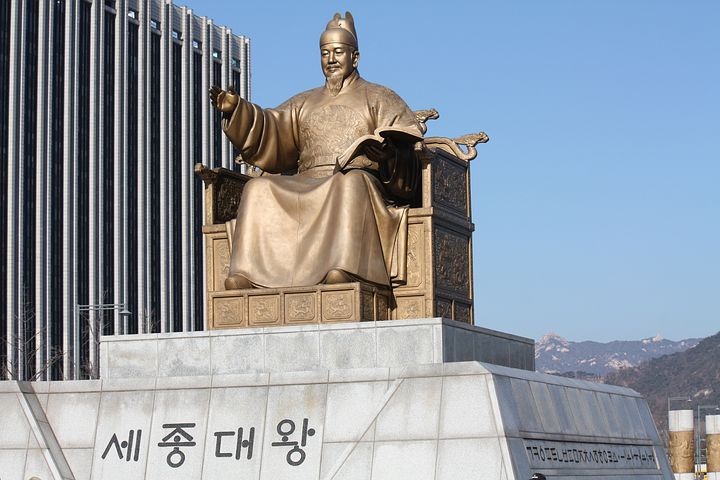
This alphabet was invented by Sejong the Great (세종대왕), ascended to the throne at just 21 years old, after the abdication of his rebellious older brother.
He was a very revolutionary king who was fundamental to the development of Korea and, for this reason, he earned the title of "great".
Returning to our Hangul, it was completed between 1443 and 1444 and thanks to a document published two years later – the Hunmin Jeong-eum Haerye (explanations and examples of the Korean alphabet) – it was possible to dispel a legend in which it was thought that King Sejong was inspired by an intricate lattice for the creation of the latter.
Before the invention of Hangul, the Chinese alphabet based on Hangul was used in Korea hanja, however, judged negatively by the sovereign as they were not accurate in representing the sounds exactly and were also too difficult to be learned by common people. In fact, knowing the hanja it was a privilege reserved only for the elite.
Unfortunately, however, this new alphabet accessible to all social classes was not well received by the aristocrats and in 1444 the protest of Choe Manri and other Confucians was an example of such discontent.
However, upon the death of the sovereign, hangul was prohibited by his successor King Yeonsangun (연산군) and remained used only by women and uneducated people. This was until the 19th century.
In fact, in that century Japan, which at that time was trying to hinder Korea's relations with China, saw hangul as a national symbol and, in 1894 during the Gabo Reform (갑오 개혁), hangul was adopted in official documents.
Unfortunately, however, during Japanese supremacy over Korea, the latter was banned starting from 1910.
It was finally adopted as an official language only in 1945 when Korea once again became an independent state.
Nowadays there is a holiday to celebrate the anniversary of the birth of the hangŭl/chosŏngŭl which falls on October 9 in South Korea and January 15 in North Korea.
Beatrice Borrello
Photo by pixabay.com